wagtail.org: sustainability audit
At a glance
- 46.9/100 — scoped audit score
15 passing, 4 with problems, 13 needing more evidence. - 7 pages reviewed
1 visitor journey and 18 selected source files. - 32 of 71 guideline groups scored
39 untested; 0 not applicable. Tests cover selected aspects of each guideline.
Results by WSG area
| Area | Passing | Guideline groups checked | Needs evidence |
|---|---|---|---|
| User experience design | 50% (6/12) | 12 of 17 | 3 |
| Web development | 36% (4/11) | 11 of 16 | 6 |
| Hosting, infrastructure and systems | 75% (3/4) | 4 of 12 | 1 |
| Business strategy and product management | 40% (2/5) | 5 of 26 | 3 |
Passing percentages apply to the selected checks. Full-guideline conformance has not been established.
Page measurements
| Page | First load | After cookies | After scrolling | Estimated footprint | Carbon rating | Browser energy | Network energy |
|---|---|---|---|---|---|---|---|
| Homepage | 944.4 kB · partial | Reject optional cookies: 944.4 kB · partial Accept cookies: 945.6 kB · partial | Reject optional cookies: 1.108 MB · partial Accept cookies: 1.109 MB · partial | Withheld | Withheld | 12.08 mWh | 11.65 mWh |
| Wagtail Features | 639.0 kB · partial | Reject optional cookies: 639.0 kB · partial Accept cookies: 638.0 kB · partial | Reject optional cookies: 719.6 kB · partial Accept cookies: 718.5 kB · partial | Withheld | Withheld | Not sampled | Not sampled |
| Wagtail 8.1: automate more with an improved API and agent-ready tools | 2.026 MB · partial | Reject optional cookies: 2.026 MB · partial Accept cookies: 2.032 MB · partial | Reject optional cookies: 2.028 MB · partial Accept cookies: 2.034 MB · partial | Withheld | Withheld | 16.41 mWh | 25.26 mWh |
| Search results | 465.5 kB · partial | Reject optional cookies: 465.5 kB · partial Accept cookies: 464.7 kB · partial | Reject optional cookies: 465.5 kB · partial Accept cookies: 464.7 kB · partial | Withheld | Withheld | Not sampled | Not sampled |
| Sustainability | 592.3 kB · partial | Reject optional cookies: 592.3 kB · partial Accept cookies: 590.3 kB · partial | Reject optional cookies: 635.2 kB · partial Accept cookies: 633.3 kB · partial | Withheld | Withheld | 13.84 mWh | 7.51 mWh |
| Wagtail Privacy policy | 465.0 kB · partial | Reject optional cookies: 465.0 kB · partial Accept cookies: 464.4 kB · partial | Reject optional cookies: 465.0 kB · partial Accept cookies: 464.4 kB · partial | Withheld | Withheld | Not sampled | Not sampled |
| Contact Us | 465.7 kB · partial | Reject optional cookies: 465.7 kB · partial Accept cookies: 464.9 kB · partial | Reject optional cookies: 465.7 kB · partial Accept cookies: 464.9 kB · partial | Withheld | Withheld | Not sampled | Not sampled |
Estimated annual footprint
A traffic scenario of 572,851 pageviews/year gives the estimates below. These are alternative views of overlapping activity, so they should not be added together.
| Scope | Annual estimate | If per-view impact fell by 10% |
|---|---|---|
| Site browsing · SWDM v4 · partial transfers | 67.89 kgCO₂e/year | 6.79 kgCO₂e/year less |
| Client electricity · GreenFrame scenarios | 8.08 kWh/year | 0.81 kWh/year less |
| Client operational emissions · assumed electricity mix | 3.99 kgCO₂e/year | 0.40 kgCO₂e/year less |
The 10% column shows the scale of a hypothetical improvement, not a predicted saving from the findings below.
Priorities
Wagtail.org already delivers compressed text, long-lived public assets, many WebP images and a home video that waits for playback. The clearest fixes are analytics requests sent before the stated measurement choice, contact email that disappears without JavaScript, inconsistent footprint quantities and live theme changes. Test an accessible on-demand YouTube player as the main transfer-reduction experiment. All fourteen measured visits have incomplete transfer measurements: the sizes below show captured data, not complete page weights. This report does not calculate a new emissions estimate or assign a Digital Carbon Rating from those partial measurements.
1. Make the measurement choice work before analytics starts
High priority · Problem found · WSG 2.6: Avoid being manipulative or deceptive
What we found. All seven sampled pages send Google Analytics page-view requests before the visitor chooses Opt in or Opt out. The analytics scripts also load before the choice in all fourteen separate visits. Both buttons work, but hiding the prompt does not demonstrate that optional measurement was prevented.
Why it matters. Visitors are offered a choice about measuring website use after the observed measurement requests have begun. This finding concerns the request sequence; cookie storage, all collection semantics and legal compliance were not established.
Next step. Review the deployed tag/container configuration and the purpose of each analytics destination. Gate optional measurement as declared, then verify fresh no-choice, reject, accept, reload and withdrawal states using requests and storage. Align the banner and privacy wording with the resulting behavior.
How we checked this: Make the measurement choice work before analytics starts
2. Test an accessible on-demand player for the release article
High priority · Needs investigation · WSG 3.3: Modularize bandwidth-heavy components
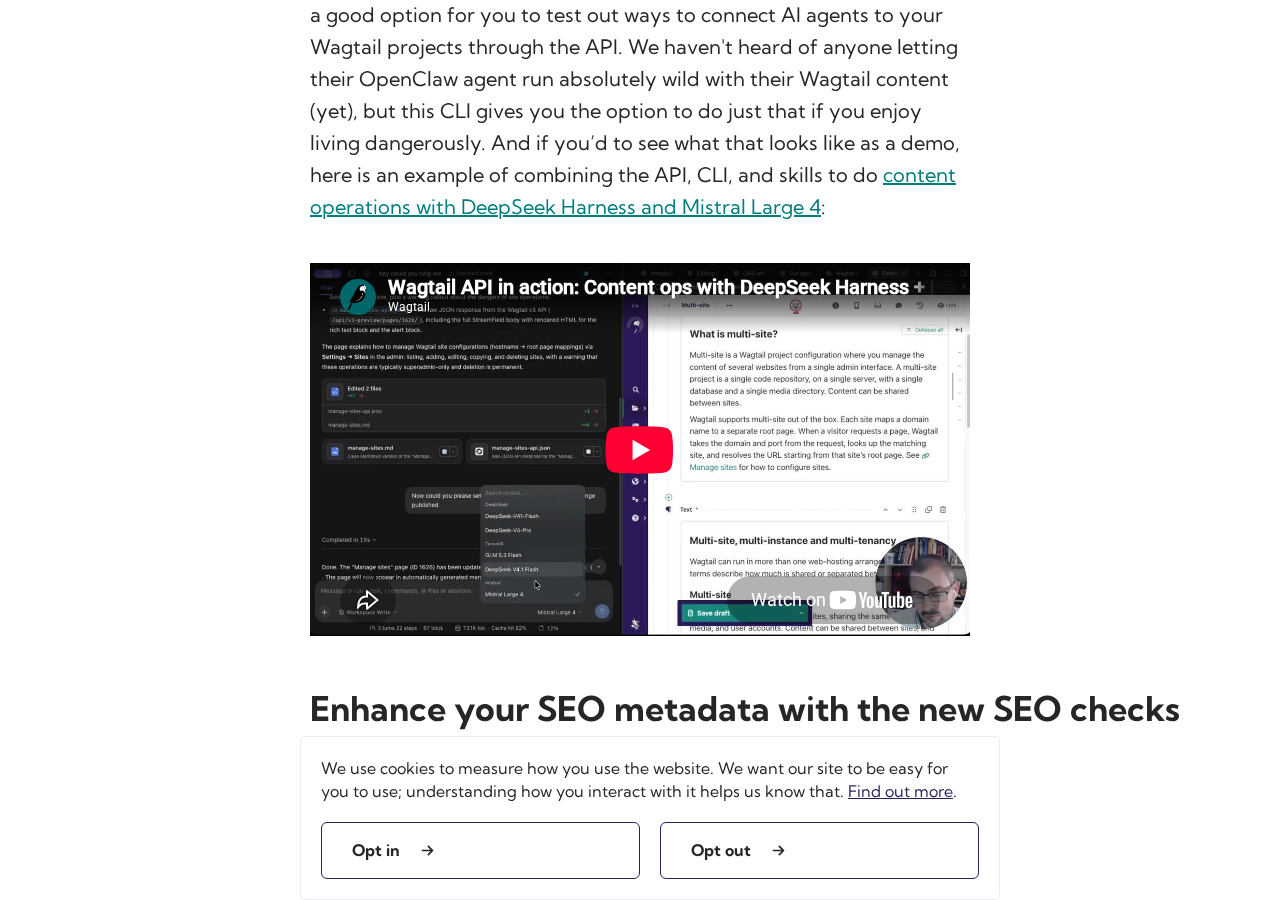
What we found. The Wagtail 8.1 article initializes YouTube before a play action, loading player scripts, fonts, thumbnail and ad/log requests. The initial reject visit captures 1.328 MB of associated traffic within 2.026 MB of recorded page traffic. These are incomplete observations with unresolved transfers and frame gaps, not a complete player footprint or a guaranteed saving.
Why it matters. A visitor reading the article currently initializes the third-party player without choosing playback. The home native video already avoids preloading, showing a useful existing pattern; an equally usable article alternative still needs validation.
Next step. Prototype a clearly named thumbnail/play control that loads the existing player on request. Verify keyboard activation, captions, transcript or reading fallback and successful playback, then compare fresh-load transfers before quantifying savings.
How we checked this: Test an accessible on-demand player for the release article
3. Keep contact and security email available without scripts
Medium priority · Problem found · WSG 2.17: Provide cross-platform compatibility support
What we found. In the fresh no-JavaScript Contact state, hello@wagtail.org and security@wagtail.org become [email protected] with Cloudflare decoder links. General/conduct and security visitors lose the readable email routes; FAQ and Slack links remain.
Why it matters. Someone finding a contact or security-reporting route needs a usable destination even when scripts are unavailable. The other six sampled reading pages retain their core content, so the demonstrated problem is specific to these contact routes.
Next step. Render readable addresses and working mailto targets in baseline HTML, or provide an explicit equivalent that works without JavaScript. Verify each general, conduct and security route with scripts disabled.
How we checked this: Keep contact and security email available without scripts
4. Reconcile the footprint figures and clarify privacy scope
Medium priority · Problem found · WSG 2.7: Make deliverables understandable and reusable
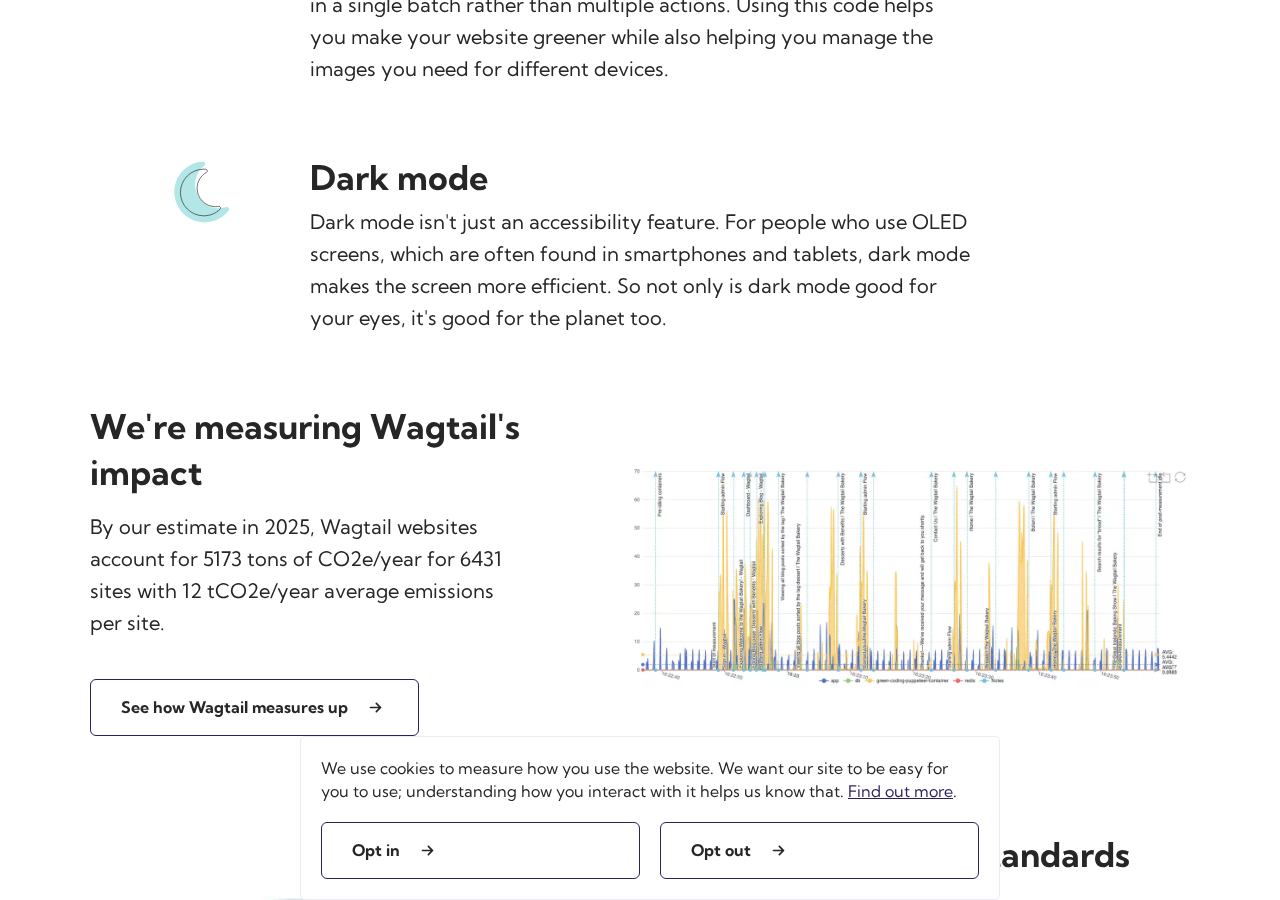
What we found. The policy gives 5,173 tCO2e/year across 6,431 sites and an average of 12 tCO2e/year per site. The displayed total divided by the count gives about 0.8044, so these cannot be the same mean and population. Separately, the privacy page describes the Torchbox website/company while being presented as the wagtail.org policy.
Why it matters. Readers need matching populations, units and periods to interpret an ecosystem footprint, and a clear service/controller scope to understand this website’s data handling. Differing 2024 baseline totals and median page weights in linked reports need explanation; a sample, method or data revision may account for them, so they are not established errors or proof of changed efficiency.
Next step. Check the underlying 2025 dataset before changing the summary: about 0.80 tCO2e/site/year applies only if the displayed total/count define the intended mean. Label any different statistic explicitly, reconcile baseline versions and clarify wagtail.org privacy coverage and actual services. Keep ecosystem and website estimates separate.
How we checked this: Reconcile the footprint figures and clarify privacy scope
5. Update the theme when the device preference changes
Medium priority · Problem found · WSG 3.9: Use media queries that support sustainability goals
What we found. Fresh loads with a dark device preference work and preserve task text. Changing that preference while any of the seven pages is already open leaves the light colors unchanged.
Why it matters. Visitors whose device changes theme should receive the expected presentation without reloading, subject to their explicit website choice. The audit does not infer energy savings from dark colors or establish a separate motion failure.
Next step. Confirm the manual-choice policy and deployed listener, then respond to system-theme changes when no override applies. Test both directions, persisted explicit choices and fresh loads.
How we checked this: Update the theme when the device preference changes
Further checks
These outcomes apply to the selected checks and sample. Open a check's explanation for the observation, limitations and useful follow-up.
Browse all check outcomes
Next steps for auditing
- Verify consent with fresh profiles across no choice, reject, accept, reload and withdrawal; inventory deployed analytics and align the privacy service/controller scope. Decide which measurements are needed before removing or repairing tags.
- Test an accessible on-demand release player and legible responsive image variants. Compare complete fresh desktop and narrow visits at intended pixel densities; preserve existing WebP delivery, useful lazy loading and cache/compression policies.
- Confirm contact/security email without scripts, live and fresh theme behavior, and narrow navigation/search. Diagnose the shared 10 px overflow and inspect motion properties rather than assuming content loss or uncontrolled animation.
- Reconcile ecosystem quantities and baseline versions with their underlying datasets. Validate carbon.txt against its declared version if formal conformance is needed, and obtain independent hosting evidence before applying green-hosting assumptions. Public mobile homepage estimates remain separate from current partial desktop observations.
- Match the supplied local revision to the deployed build before choosing source edits. Supply lockfile/build evidence, applicable license/contribution documents and the numerical DebugBear budget with its response owner and alert history.
Broader checks to add next
These checks need additional evidence and are outside the current score. Missing records do not establish a site defect.
| Check | Evidence so far | Next step |
|---|---|---|
| Governance practice | The site describes commitments and CMS improvements; accountable review of the website commitment remains unverified. | Find a dated website progress review naming the responsible role, result and response. |
| Sustainability goals | The page states a direction and a CMS-wide estimate, but no comparable website baseline and progress series was captured. | Follow the linked roadmap and measurement method for a website-specific metric, baseline and progress record. |
| Data minimization | The visible newsletter form asks only for an email address with a clear purpose. This is a limited pre-submission strength. | Keep the small form; review the next step and clarify privacy and unsubscribe scope before assessing the complete signup. |
The sample covers selected pages and visitor tasks, not every page on the site. Expand it where the checks above identify an untested template, interaction or audience need.
Detailed findings
This appendix explains the evidence in ordinary language. Local source files help identify possible fixes, but we have not confirmed that the live site uses the same code revision. A missing selected file or document does not mean the organization has none.
User experience design
Reading without unsolicited interruptions
Passed this check · WSG 2.5: Design to assist and not to distract
Give users control over notifications and focus, prioritize task-relevant content, and avoid designs that distract or unnecessarily extend engagement.
The seven sampled pages provide relevant reading, search, policy and contact content. The home video is paused with controls and no autoplay; static conference and newsletter prompts did not interrupt the recorded tasks. Hidden dialogs and a hidden copy confirmation are not evidence of unsolicited popups.
Next step: Extend observation to longer visits, opened menus and player states if those are important visitor tasks.
Where we looked:
- Browser observations for Homepage.
- Browser observations for Features.
- Browser observations for Wagtail 8 1.
- Browser observations for Search results.
- Browser observations for Sustainability.
- Browser observations for Privacy.
- Browser observations for Contact.
Make the analytics choice effective
Problem found · WSG 2.6: Avoid being manipulative or deceptive
Avoid deceptive patterns, clearly label ads, respect consent for tracking, and ensure search, sharing, and discoverability practices prioritize user needs over optimization or manipulation.
All seven initial page captures send Google Analytics page-view requests before the visitor chooses Opt in or Opt out. Google Tag Manager, gtag and analytics.js already load before either choice in all fourteen separate visits. Both choice buttons worked and the opt-out/search journey completed, but dismissal does not demonstrate that optional measurement was blocked. Storage, later visits and visual parity remain untested; this is not a legal compliance verdict.
Next step: Audit the deployed analytics destinations and consent configuration. Verify request payloads and storage in fresh no-choice, reject, accept, reload and withdrawal states, then align optional measurement with the stated choice.
Where we looked:
- Browser observations for Homepage.
- Browser observations for Features.
- Browser observations for Wagtail 8 1.
- Browser observations for Search results.
- Browser observations for Sustainability.
- Browser observations for Privacy.
- Browser observations for Contact.
- Captured public evidence for Homepage.
- Captured public evidence for Features.
- Captured public evidence for Wagtail 8 1.
- Captured public evidence for Search results.
- Captured public evidence for Sustainability.
- Captured public evidence for Privacy.
- Captured public evidence for Contact.
- Selected local file
wagtailio/project_styleguide/templates/patterns/includes/cookie_message.htmlat revision9fa65385f27c. - Selected local file
wagtailio/static/js/components/cookie-message.jsat revision9fa65385f27c.
Reconcile the footprint summary and privacy scope
Problem found · WSG 2.7: Make deliverables understandable and reusable
Create discoverable, maintainable, and reusable documentation and code resources that support long-term understanding, reuse, and sustainability.
The sustainability policy reports 5,173 tCO2e/year for 6,431 sites alongside a 12 tCO2e/year per-site average. Dividing the displayed total by the count gives about 0.8044 tCO2e/site/year; those quantities cannot describe the same mean. The privacy page describes the Torchbox website/company despite being presented as the wagtail.org policy, leaving its service/controller scope unclear. Other sampled task copy is reasonably explanatory; truncated heading lists do not establish a broken hierarchy.
Next step: Check the intended dataset, period, population and units before correcting the average or labeling a different statistic. Clarify the wagtail.org privacy scope and actual services, and review the resulting copy with its audience.
Where we looked:
- Browser observations for Homepage.
- Browser observations for Features.
- Browser observations for Wagtail 8 1.
- Browser observations for Search results.
- Browser observations for Sustainability.
- Browser observations for Privacy.
- Browser observations for Contact.
- Captured public evidence for Homepage.
Keep the familiar navigation and control names
Passed this check · WSG 2.8: Use a design system for interface consistency
Use design systems and established patterns to ensure consistent, efficient, and sustainable interfaces through reusable components and clear maintenance practices.
The same primary navigation, footer groups, search, Get started, theme and cookie-choice wording recur across all seven pages. Search and article pages add controls appropriate to their content. This supports consistency in the sample; it does not establish a documented design system or every expanded menu state.
Next step: Compare opened menus, narrow layouts and any additional content types when expanding the interface review.
Where we looked:
- Browser observations for Homepage.
- Browser observations for Features.
- Browser observations for Wagtail 8 1.
- Browser observations for Search results.
- Browser observations for Sustainability.
- Browser observations for Privacy.
- Browser observations for Contact.
Investigate transient motion before changing it
Needs investigation · WSG 2.10: Ensure animation is proportionate and easy to control
Use animation sparingly and efficiently, only when it supports understanding, while limiting performance impact and giving users control over motion.
Initial desktop snapshots show no running animation and the home video is paused. Resizing and reduced-motion states record five, two and one one-iteration animations on Home, Features and Sustainability respectively. The captured records omit animated properties, duration and purpose, so they do not establish uncontrolled looping or harmful motion; embedded playback is also untested.
Next step: Inspect actual properties, purpose, duration and controls after resize, menus and scrolling. Compare settled and fresh reduced-motion states before deciding what to reduce.
Where we looked:
- Browser observations for Homepage.
- Browser observations for Features.
- Browser observations for Wagtail 8 1.
- Browser observations for Search results.
- Browser observations for Sustainability.
- Browser observations for Privacy.
- Browser observations for Contact.
No notification request during the reading tasks
Passed this check · WSG 2.12: Avoid unwanted notifications
Send only user-requested notifications and provide clear, accessible controls for managing preferences, opt-in, and account and contact settings.
No browser notification permission request was recorded in the sampled states. Newsletter signup is optional and recorded dialogs/confirmation alerts are hidden. Browser permission was already denied, so this result covers attempted requests during these tasks rather than every subscription or external message.
Next step: Use default browser permission and a deliberately requested signup task if extending this check.
Where we looked:
- Browser observations for Homepage.
- Browser observations for Features.
- Browser observations for Wagtail 8 1.
- Browser observations for Search results.
- Browser observations for Sustainability.
- Browser observations for Privacy.
- Browser observations for Contact.
Readable HTML and a simpler print view
Passed this check · WSG 2.13: Reduce the impact of downloadable and physical documents
Reduce paper use through digital-first workflows, optimize and reuse accessible downloadable documents, and provide clear, user-controlled document previews and formats.
The sampled tasks use HTML, with no recorded PDF, office-file or download-attributed links. Print states retain the reading content while hiding navigation, cookie controls and unrelated recommendations; the article keeps eight of eleven images after related author images are removed. Actual pagination, paper use and downloadable-document accessibility were not inspected.
Next step: Inspect print preview and pagination for long feature and release pages before claiming paper savings or optimized printing.
Where we looked:
- Browser observations for Homepage.
- Browser observations for Features.
- Browser observations for Wagtail 8 1.
- Browser observations for Search results.
- Browser observations for Sustainability.
- Browser observations for Privacy.
- Browser observations for Contact.
The opt-out and policy-search task completes
Passed this check · WSG 2.4: Design efficient and streamlined user journeys
Design clear, efficient journeys that help users complete tasks and find content with minimal effort.
All five declared actions completed: opt out, open desktop search, enter sustainability, submit and follow the policy result. The final URL, title, heading and reading text identify the Sustainability page, and the separate results sample lists it first among 62 results. This confirms that task path; it does not establish optimal efficiency or analytics enforcement.
Next step: Repeat with new visitors and narrow navigation, and test consent enforcement independently of banner dismissal.
Where we looked:
- Browser observations for Homepage.
- Browser observations for Search results.
- Browser observations for Sustainability.
Compare responsive images while keeping readable detail
Needs investigation · WSG 2.9: Optimize media to reduce resource use
Include media only when it supports user needs. Manage, optimize, and load media efficiently. Ensure users have control over playback and data use.
Many image URLs already deliver WebP, and scrolling confirms useful deferral of three home images, two feature images and one sustainability image. The home video also avoids preloading. None of the sampled images uses srcset/sizes: the 2,234 px home illustration renders at 1,280 px desktop and 360 px narrow, with a 370,360-byte response body; feature screenshots are 1,300 px for 660/300 px display and article screenshots 800–900 px for 660/300 px. These are investigation targets, not validated smaller replacements. Tests use DPR 1 and the same resized document. Two article screenshots actually remain PNG; four sustainability WebP resources render but use application/octet-stream. Early unloaded lazy images are not evidence of broken media.
Next step: Compare legible responsive variants at intended 1x/2x densities, retaining art direction and useful screenshot text. Test fresh narrow loads and deferred loading, and inspect the mixed MIME responses before changing formats or claiming savings.
Where we looked:
- Browser observations for Homepage.
- Browser observations for Features.
- Browser observations for Wagtail 8 1.
- Browser observations for Search results.
- Browser observations for Sustainability.
- Browser observations for Privacy.
- Browser observations for Contact.
- Captured public evidence for Homepage.
- Captured public evidence for Features.
- Captured public evidence for Wagtail 8 1.
- Captured public evidence for Search results.
- Captured public evidence for Sustainability.
- Captured public evidence for Privacy.
- Captured public evidence for Contact.
- Selected local file
wagtailio/project_styleguide/templates/patterns/pages/home/home_page.htmlat revision9fa65385f27c. - Selected local file
wagtailio/project_styleguide/templates/patterns/components/streamfields/video_block/video_block.htmlat revision9fa65385f27c. - Selected local file
wagtailio/project_styleguide/templates/patterns/components/streamfields/image/image.htmlat revision9fa65385f27c.
Test font fallback before trimming variants
Needs investigation · WSG 2.11: Use optimized web typography
Use font strategies that minimize downloads and complexity while supporting required languages and dynamic content.
The English content uses Kumbh Sans with a sans-serif fallback. Weights 400 and 700 load on every page; 600 loads only on the article. The ordinary-page local faces account for about 39.5–40.8 kB including reported overhead; the article local faces account for 61.172 kB in initial reject, separate from 40.678 kB of player Roboto. Regular declares font-display:block and other weights auto. Slow or blocked font loading and language needs were not tested, so no face is established as safely removable.
Next step: Test blocked/slow responses, fallback readability, layout changes and intended languages before changing font-display, removing weights or subsetting.
Where we looked:
- Browser observations for Homepage.
- Browser observations for Features.
- Browser observations for Wagtail 8 1.
- Browser observations for Search results.
- Browser observations for Sustainability.
- Browser observations for Privacy.
- Browser observations for Contact.
- Captured public evidence for Homepage.
- Captured public evidence for Features.
- Captured public evidence for Wagtail 8 1.
- Captured public evidence for Search results.
- Captured public evidence for Sustainability.
- Captured public evidence for Privacy.
- Captured public evidence for Contact.
Keep contact email readable without JavaScript
Problem found · WSG 2.17: Provide cross-platform compatibility support
Document compatibility, avoid unnecessary obsolescence, and test across devices, systems, and network conditions.
The fresh no-JavaScript Contact page replaces the general/conduct address hello@wagtail.org and security@wagtail.org with [email protected] and Cloudflare decoder links. FAQ and Slack remain, but neither supplies an explicit equivalent security-email route. Core reading/navigation on the other six pages remains available; no-JavaScript search submission and every interactive control were not tested.
Next step: Render readable email addresses and working mailto links in baseline HTML, or provide a tested explicit equivalent that needs no script. Verify the general, conduct and security routes with JavaScript disabled.
Where we looked:
- Browser observations for Homepage.
- Browser observations for Features.
- Browser observations for Wagtail 8 1.
- Browser observations for Search results.
- Browser observations for Sustainability.
- Browser observations for Privacy.
- Browser observations for Contact.
Public disclosures identify services and mitigation
Passed this check · WSG 2.1: Identify, assess, disclose, review, and mitigate sustainability impacts
Assess and report the planet, people, and prosperity impacts of digital projects, and plan measurable reductions to the real-world effects of their activity.
The sustainability policy explicitly includes wagtail.org, docs.wagtail.org and guide.wagtail.org alongside CMS/ecosystem and community work. The linked Digital emissions statement separates homepage/website estimates and describes method, period and monitoring. This passes disclosure coverage, not execution or footprint accuracy. Its April 2026 mobile/Lighthouse SWD v4 estimate is a different scenario from these partial desktop captures and is not reproduced here. The 2025 ecosystem article uses differing 2024 totals (6,327 and 6,260 tons) and a median page weight differing from the earlier report. A sample, method or data revision could explain those baseline differences; the bounded excerpts do not establish one. The article itself warns that estimated pageview changes drive much of the headline reduction.
Next step: Explain comparable baseline versions and distinguish ecosystem, website and homepage estimates. Correct the policy average, obtain execution records for claimed reductions, and supply traffic period/count, first/repeat mix, page weighting and infrastructure inputs to reproduce the site estimate. Its 30–300 kg/year range is a methodological scenario range, not statistical bounds.
Where we looked:
- Captured public evidence for Homepage.
- Browser observations for Sustainability.
Web development
Measure code across the interactions visitors use
Needs investigation · WSG 3.2: Minify and remove unused code
Minify code and data, and remove unused characters to reduce file size and improve loading efficiency and maintainability.
The deployed main JavaScript is about 39.5 kB decoded and 11.3 kB gzip; CSS is about 125.7 kB decoded and 21.1 kB gzip. Initial unexecuted functions may serve later menus, search and copy actions. CSS records show used ranges rather than all unused rules, and article/frame coverage is incomplete. The separate analytics scripts account for 347.162 kB in the initial home reject visit; they are not the first-party bundle. Local production minification is useful source context but does not identify the live build.
Next step: Collect representative interaction coverage and match deployed bundles to source maps before deleting or splitting code. Review analytics and player requirements with their owners.
Where we looked:
- Browser observations for Homepage.
- Browser observations for Features.
- Browser observations for Wagtail 8 1.
- Browser observations for Search results.
- Browser observations for Sustainability.
- Browser observations for Privacy.
- Browser observations for Contact.
- Selected local file
webpack.config.jsat revision9fa65385f27c. - Selected local file
wagtailio/project_styleguide/templates/patterns/base.htmlat revision9fa65385f27c. - Selected local file
wagtailio/static/js/main.jsat revision9fa65385f27c.
Test loading the release player only on request
Needs investigation · WSG 3.3: Modularize bandwidth-heavy components
Split large components into smaller, on-demand modules to improve loading efficiency while balancing maintainability and caching performance.
The release article initializes its YouTube iframe before playback, requesting player code, fonts, thumbnail and ad/log endpoints. The initial reject visit captures 1.328 MB of associated traffic within 2.026 MB of recorded page traffic; the separate accept visit captures 2.032 MB of page traffic. All are partial totals with unresolved transfers and frame gaps. The home native video already avoids preloading and has no observed MP4 request. A usable replacement for the article player has not yet been validated.
Next step: Prototype a named image/play preview that loads the existing player on activation. Verify keyboard access, captions, transcript or reading fallback and playback, then compare fresh-load transfers. Treat 1.328 MB as observed traffic, not a promised saving.
Where we looked:
- Browser observations for Homepage.
- Browser observations for Wagtail 8 1.
- Captured public evidence for Wagtail 8 1.
- Selected local file
wagtailio/project_styleguide/templates/patterns/pages/home/home_page.htmlat revision9fa65385f27c. - Selected local file
wagtailio/project_styleguide/templates/patterns/components/streamfields/video_block/video_block.htmlat revision9fa65385f27c.
Find the shared horizontal overflow
Needs investigation · WSG 3.10: Ensure layouts work for different devices and requirements
Use responsive, progressively enhanced, and carbon-aware design to ensure accessible, adaptable functionality across devices and interaction methods while managing resource use.
All seven JavaScript desktop documents are 1,290 px wide in a 1,280 px viewport; resized narrow documents are 370 px in a 360 px viewport. Reading text remains and images shrink, but the records do not identify the extra 10 px or show content loss. No-JavaScript and print states have no overflow. Mobile menu/search controls were visible but not activated, and resizing is not a fresh mobile load.
Next step: Identify the overflowing element, inspect clipping and scrolling, then exercise narrow menu/search with keyboard and touch on a real device.
Where we looked:
- Browser observations for Homepage.
- Browser observations for Features.
- Browser observations for Wagtail 8 1.
- Browser observations for Search results.
- Browser observations for Sustainability.
- Browser observations for Privacy.
- Browser observations for Contact.
Inspect visible headings and activated forms
Needs investigation · WSG 3.6: Ensure code follows good semantic practices
Use standards-compliant HTML and web platform features, and avoid unnecessary complexity or non-standard code.
All seven documents report English language, one main region and one H1. Search inputs have Search labels and the newsletter field has an Email name; textless controls are not automatically unnamed. The bounded heading inventories truncate inside duplicated hidden navigation before visible primary content, so counts alone cannot establish heading wording or hierarchy. Dialog activation and focus handling remain untested.
Next step: Capture visible main-region headings and resolved control names directly, then execute search, newsletter and modal tasks before making broader accessibility claims.
Where we looked:
- Browser observations for Homepage.
- Browser observations for Features.
- Browser observations for Wagtail 8 1.
- Browser observations for Search results.
- Browser observations for Sustainability.
- Browser observations for Privacy.
- Browser observations for Contact.
Useful page metadata matches the task
Passed this check · WSG 3.8: Structure metadata for machine readability
Include essential document metadata and structured data to improve usability, accessibility, and machine readability.
The six content pages have descriptive titles, matching HTTPS canonicals and relevant descriptions. Dynamic search has a query-specific title and noindex; its lack of canonical/description is appropriate to the sampled purpose. Home and the article contain parseable JSON-LD. Parsing is not schema validation or proof of search eligibility.
Next step: Validate declared schema meaning if structured-data eligibility becomes part of the scope.
Where we looked:
- Browser observations for Homepage.
- Browser observations for Features.
- Browser observations for Wagtail 8 1.
- Browser observations for Search results.
- Browser observations for Sustainability.
- Browser observations for Privacy.
- Browser observations for Contact.
Follow system theme changes on an open page
Problem found · WSG 3.9: Use media queries that support sustainability goals
Support user preferences via media queries for color, motion, contrast, data use, and related settings to improve accessibility and efficiency.
Fresh dark-preference loads work: text becomes white on a dark rgb(38,38,38) background and task content remains. In contrast, changing the device preference while each of the seven pages is open leaves the original light colors in place. Transient animation records do not independently prove a reduced-motion defect. No energy saving is inferred from the selected color scheme.
Next step: Confirm manual-override policy and the deployed theme listener. Test live light-to-dark and dark-to-light changes, explicit choices, persisted preferences and fresh loads.
Where we looked:
- Browser observations for Homepage.
- Browser observations for Features.
- Browser observations for Wagtail 8 1.
- Browser observations for Search results.
- Browser observations for Sustainability.
- Browser observations for Privacy.
- Browser observations for Contact.
Confirm which analytics and player requests are needed
Needs investigation · WSG 3.11: Use sustainable JavaScript and APIs
Write efficient JavaScript and use APIs that minimize processing, data use, and energy consumption.
Each initial page requests one small sitewide alert and three analytics page views: GA4 and two different Universal Analytics properties. Different property IDs mean similar paths are not proof of redundant events. The article also repeats player/log requests, with zero received bytes recorded for some later assets; this does not establish repeated downloads or backend waste. No long-duration polling test or destination requirements were supplied.
Next step: Inventory analytics destinations, event needs and owners; inspect consent behavior and repeated player initialization before removing work or changing dynamic search caching.
Where we looked:
- Browser observations for Homepage.
- Browser observations for Features.
- Browser observations for Wagtail 8 1.
- Browser observations for Search results.
- Browser observations for Sustainability.
- Browser observations for Privacy.
- Browser observations for Contact.
- Captured public evidence for Homepage.
- Captured public evidence for Features.
- Captured public evidence for Wagtail 8 1.
- Captured public evidence for Search results.
- Captured public evidence for Sustainability.
- Captured public evidence for Privacy.
- Captured public evidence for Contact.
Initial keyboard focus is visible
Passed this check · WSG 3.6: Ensure code follows good semantic practices
Use standards-compliant HTML and web platform features, and avoid unnecessary complexity or non-standard code.
Bounded Tab traces reach visible event/skip/home links, named navigation and search, Get started and task controls. Recorded targets show a visible focus indicator, including a 1 px automatic outline on the sampled light background. This supports the initial path only; skip destinations, opened menus, reverse traversal, traps and full accessibility were not tested.
Next step: Activate skip, search and menu controls and check complete forward/reverse paths, including narrow and dark states.
Where we looked:
- Browser observations for Homepage.
- Browser observations for Features.
- Browser observations for Wagtail 8 1.
- Browser observations for Search results.
- Browser observations for Sustainability.
- Browser observations for Privacy.
- Browser observations for Contact.
carbon.txt is present and usable for discovery
Passed this check · WSG 3.13: Include expected and beneficial files
Include standard website metadata and configuration files to support discoverability, transparency, and operational best practices.
The root carbon.txt returns 200 text/plain, parses with declared version 0.4 and supplies usable exact-host disclosure relationships without delegation ambiguity. All four declared disclosure URLs return 200. Common-field checks report no structural issue, but schemaValidated=false: this is neither full version-0.4 schema validation nor validation against the separate 1.0-RC1 profile. The 2023/2024 reports are historical and past their declared validity; last_updated is 2026-01-07. The newer 2025 report was reached through linked content, not directly declared. Provider entries remain self-declared relationships, and exact-host labels do not automatically cover subdomains.
Next step: Link the current report directly and refresh the update date when appropriate. Use a matching version-specific validator for formal syntax conformance; verify claims and hosting independently.
Where we looked:
- Captured public evidence for Homepage.
Selected local components share common behavior
Passed this check · WSG 3.4: Avoid redundancy and duplication in code
Reduce code duplication through refactoring and reuse, ensure maintainability, and favor evolving existing solutions over rebuilding them.
The supplied local home template uses shared hero/button patterns and a common CTA button include. main.js has a shared component initializer, with dedicated cookie and desktop-search modules. This supports reuse in the selected files, not whole-project efficiency. The unselected base-page inheritance and live deployment identity remain unresolved.
Next step: Inspect additional concrete template call sites only if expanding the duplication review; match proposed edits to the deployed build.
Where we looked:
- Selected local file
wagtailio/project_styleguide/templates/patterns/base.htmlat revision9fa65385f27c. - Selected local file
wagtailio/project_styleguide/templates/patterns/pages/home/home_page.htmlat revision9fa65385f27c. - Selected local file
wagtailio/project_styleguide/templates/patterns/includes/cookie_message.htmlat revision9fa65385f27c. - Selected local file
wagtailio/static/js/components/cookie-message.jsat revision9fa65385f27c. - Selected local file
wagtailio/static/js/components/site-search-desktop.jsat revision9fa65385f27c. - Selected local file
wagtailio/static/js/main.jsat revision9fa65385f27c.
Verify lockfile contents or a repeatable build
Needs investigation · WSG 3.12: Use dependencies sparingly and maintain them
Regularly review dependencies, remove unused or unnecessary libraries and frameworks, and keep required packages up to date. Opt for minimal, secure, and modular solutions.
Local manifests inventory dependencies, while Docker/CI declare npm ci and Poetry installation. The selected lockfiles contain identity/size metadata only, so their resolutions and consistency with manifests cannot be checked. Clean tracked source does not establish installed/deployed versions, package necessity or vulnerability status.
Next step: Provide bounded lockfile/manifest checks or a clean-install receipt for this revision. Verify deployed versions separately where they affect a decision.
Where we looked:
- Selected local file
pyproject.tomlat revision9fa65385f27c. - Selected local file
package.jsonat revision9fa65385f27c. - Selected local file
poetry.lockat revision9fa65385f27c(metadata only). - Selected local file
package-lock.jsonat revision9fa65385f27c(metadata only). - Selected local file
Dockerfileat revision9fa65385f27c. - Selected local file
.github/workflows/ci.ymlat revision9fa65385f27c.
Local runtime declarations agree
Passed this check · WSG 3.15: Use the latest stable language version
Use up-to-date technologies and select the most suitable programming language for each task to ensure efficiency and maintainability.
Selected local declarations agree on Python 3.14 and Node 24 across project metadata, runtime files, Docker and CI; Docker/CI also agree on Poetry 2.4.0. This passes declaration consistency. Unselected runtime paths and the deployed inventory are unknown, and no authoritative release check establishes a latest-version claim.
Next step: Capture other supported runtime paths and a deployed inventory if broader consistency is required.
Where we looked:
- Selected local file
pyproject.tomlat revision9fa65385f27c. - Selected local file
Dockerfileat revision9fa65385f27c. - Selected local file
.nvmrcat revision9fa65385f27c. - Selected local file
.github/workflows/ci.ymlat revision9fa65385f27c. - Selected local file
README.mdat revision9fa65385f27c.
Hosting, infrastructure and systems
Keep the explicit public-asset cache policies
Passed this check · WSG 4.2: Optimize caching and support offline access
Use caching and offline capabilities to reduce network load, improve resilience, and balance performance with sustainability.
Hashed JavaScript, CSS and WOFF2 expose long public immutable caching and validators; remote media has long caching and validators, and sitewide alerts have an explicit shorter policy. Dynamic search and private analytics/log responses have different reuse needs. The observed policies pass this check; no warm-visit test establishes actual reuse or offline support.
Next step: Check repeat visits and invalidation after content changes before quantifying cache benefits or claiming offline capability.
Where we looked:
- Browser observations for Homepage.
- Browser observations for Features.
- Browser observations for Wagtail 8 1.
- Browser observations for Search results.
- Browser observations for Sustainability.
- Browser observations for Privacy.
- Browser observations for Contact.
- Captured public evidence for Homepage.
- Captured public evidence for Features.
- Captured public evidence for Wagtail 8 1.
- Captured public evidence for Search results.
- Captured public evidence for Sustainability.
- Captured public evidence for Privacy.
- Captured public evidence for Contact.
Material text responses already use compression
Passed this check · WSG 4.3: Reduce data transfer with compression
Compress server responses and media files to reduce bandwidth, storage use, and delivery overhead while balancing processing costs.
Sampled HTML uses Brotli and common CSS/JavaScript gzip; material third-party text also has compression. Main CSS is 21,060 encoded bytes versus about 125.7 kB decoded, and main JavaScript is 11,338 versus about 39.5 kB. Unencoded tiny acknowledgments, helper responses and errors do not establish a material omission; already-compressed images and WOFF2 do not need blanket recompression. Partial traffic totals do not invalidate observed encoding headers.
Next step: Retain current material text compression. No additional evidence is needed for this sampled encoding check.
Where we looked:
- Browser observations for Homepage.
- Browser observations for Features.
- Browser observations for Wagtail 8 1.
- Browser observations for Search results.
- Browser observations for Sustainability.
- Browser observations for Privacy.
- Browser observations for Contact.
- Captured public evidence for Homepage.
- Captured public evidence for Features.
- Captured public evidence for Wagtail 8 1.
- Captured public evidence for Search results.
- Captured public evidence for Sustainability.
- Captured public evidence for Privacy.
- Captured public evidence for Contact.
Verify hosting claims beyond provider names
Needs investigation · WSG 4.1: Use sustainable hosting
Select and manage infrastructure using sustainability metrics, prioritizing low-carbon energy use and low-impact hosting and domain choices in selection, and extending hardware lifespan and minimising emissions in management.
carbon.txt declares Cloudflare for CDN, Heroku for platform/database/cache, AWS for object storage and GitHub for CI/CD. Local documentation also describes Heroku, and the public site estimate uses an Ireland factor. These do not independently establish this origin’s current region, electricity supply or operational metrics. No verified green-hosting assumption follows.
Next step: Obtain dated origin/provider/service/region correspondence and independent environmental evidence matching that operational scope.
Where we looked:
- Captured public evidence for Homepage.
- Selected local file
Dockerfileat revision9fa65385f27c. - Selected local file
README.mdat revision9fa65385f27c.
CI already cancels superseded runs
Passed this check · WSG 4.6: Use automation wisely
Automate and scale tasks and infrastructure efficiently, run processes only when needed, and control unwanted traffic.
The selected local workflow filters push runs to main/next, supports pull requests, groups concurrency by workflow/ref and sets cancel-in-progress=true. Lock/runtime-keyed caches and ordered checks are also present. The frozen evidence does not demonstrate redundant same-context jobs or measured CI savings; actual execution and possible cross-event overlap require history.
Next step: Inspect run history and the relevant hook contents before reducing validation. Keep needed lint, build and backend checks and retain the existing cancellation mechanism.
Where we looked:
- Selected local file
.github/workflows/ci.ymlat revision9fa65385f27c.
Business strategy and product management
Check useful context for optional video
Needs investigation · WSG 5.4: Communicate the environmental impact of user choices
Empower users, allowing them to make decisions when their choices can influence the environmental impact they have.
Ordinary reading links do not all need carbon labels. Optional video is a more consequential resource choice: the home player defers downloading while the article initializes YouTube before activation. The packet does not inspect player quality, duration or data-use information. Policy descriptions of OLED themes and image capabilities concern CMS use rather than an executed upload task here.
Next step: Review the information visitors need to choose video playback, then test it alongside an accessible on-demand player.
Where we looked:
- Browser observations for Homepage.
- Browser observations for Wagtail 8 1.
- Browser observations for Sustainability.
Local documentation explains maintenance tasks
Passed this check · WSG 5.10: Follow a product management and maintenance strategy
Maintain clear documentation, resourcing, and measurement practices for long-term product support, including security, sustainability, and early detection of failure risks.
The supplied README describes development setup, migrations, cache setup, controlled data/media retrieval, frontend commands and deployment; CI records explicit test commands. This passes the selected maintenance-documentation check. Staffing, cadence, operational execution and correctness of unselected auxiliary paths remain unverified.
Next step: Obtain maintenance ownership, cadence and operational records if assessing the wider maintenance strategy.
Where we looked:
- Selected local file
README.mdat revision9fa65385f27c. - Selected local file
.github/workflows/ci.ymlat revision9fa65385f27c.
The release article explains product changes
Passed this check · WSG 5.12: Document updates and evolutions
Provide documentation to help users find their way whenever functionality changes.
The public Wagtail 8.1 article identifies the version and user-facing API/workflow/metadata/sitemap changes, labels preview or prototype features and links full release notes with upgrade implications. This passes the sampled product-change disclosure task. It is not a complete history of changes to the wagtail.org application or proof every affected user received the announcement.
Next step: Request a website-specific change history if the question concerns the wagtail.org implementation itself.
Where we looked:
- Browser observations for Wagtail 8 1.
Make the stated monitoring target reviewable
Needs investigation · WSG 5.24: Define performance, environmental, and human budgets
Define and apply lifecycle sustainability and performance budgets, set evidence-based KPIs, and track measurable improvements over time.
Selected local build/CI/docs do not expose a numerical asset/performance ceiling and response when exceeded. Linters, minification and a development statistics option do not establish one. The public Digital emissions page does state that weekly DebugBear monitoring alerts against a target, so this is missing reviewable detail rather than proof that no budget exists.
Next step: Supply the numeric target, relevant page/device protocol, alert/build configuration, response owner and exceedance procedure, with alert/history evidence.
Where we looked:
- Selected local file
package.jsonat revision9fa65385f27c. - Selected local file
.github/workflows/ci.ymlat revision9fa65385f27c. - Selected local file
README.mdat revision9fa65385f27c. - Selected local file
webpack.config.jsat revision9fa65385f27c. - Captured public evidence for Homepage.
Clarify software and content reuse terms
Needs investigation · WSG 5.25: Use and contribute to open source
Define and maintain an open-source policy and actively contribute to open-source communities through code, time, and financial or in-kind support.
Local Python metadata declares BSD-3-Clause and package metadata ISC, while the README links the public repository. Actual license and contribution documents were not selected, so the applicable terms and process remain unresolved. Public restrictions on website material have a separate scope; they do not automatically override software terms, and CMS open-source wording does not license all website media.
Next step: Provide applicable license/contribution documents, explain the scope of each manifest declaration, and distinguish source-code permissions from website content permissions.
Where we looked:
- Selected local file
pyproject.tomlat revision9fa65385f27c. - Selected local file
package.jsonat revision9fa65385f27c. - Selected local file
README.mdat revision9fa65385f27c. - Browser observations for Privacy.
Methodology and reproducibility
The browser measurements were captured from 2026-11-04T19:24:59.321438+00:00 to 2026-11-04T19:28:05.355133+00:00. Initial-load tests used a 1280 × 800 desktop viewport and a 3-second observation window. Cookie choices and scrolling were recorded afterward. Supplementary tests covered narrow layouts, color and motion preferences, print, JavaScript availability and bounded keyboard navigation.
Audit judgments: Codex native subagent, gpt-6.1-sol, high reasoning. Report wording: Codex native subagent, gpt-6.1-sol, high reasoning.
The scoring method is agent-breadth-v2. A guideline group counts once even if it has several checks. Observed problems take precedence over unresolved checks in that group. 0 groups were excluded as not applicable; 39 were untested. Unknowns remain in the passing-percentage denominator; untested and inapplicable groups do not. Area percentages use the same rule as the overall score.
First load
Data downloaded before clicking or scrolling, using the first recorded initial visit for each URL, including its completeness limit. Decimal kB = 1,000 bytes; MB = 1,000,000 bytes.
Cookie choices and waiting
Each cookie choice starts a separate fresh visit. Accept and reject results stay separate; they are not combined into a median. The first-load column uses the first of those visits. Later columns show cumulative totals, including the initial load of that visit. They are not additional amounts to add together or guaranteed savings.
Scrolling
Cumulative downloads after scrolling to the bottom, following the cookie-choice or waiting checkpoint of the same visit. Compare accept and reject values within their own visit; do not subtract the first-load headline from a different visit.
Partial measurements
A partial result means some requests failed or did not finish in the observation window, so their transferred size is uncertain. The site is measured as it behaved; a failed analytics request is context, not automatically a priority fix. Carbon estimates and ratings are withheld for incomplete initial captures. Unmarked transfer figures are complete within the test conditions, not a measure of every possible download.
Estimated footprint and Digital Carbon Rating
Both use the same initial visit as the first-load column. Footprints are estimates in grams of carbon dioxide equivalent (gCO₂e) per first visit. They display two decimal places, with a minimum of 0.01 gCO₂e for positive estimates. Digital Carbon Ratings use unrounded estimates from the fixed comparison model. Recorded model: Sustainable Web Design Model version 4 through @tgwf/co2@0.19.0, assuming 100% first visits. The comparison gives no green-hosting credit. These are model assumptions, not verified electricity-supply facts. Ratings remain provisional because the capture protocol has not been independently validated; they do not establish whole-site sustainability.
Browser and network energy
Energy is shown in milliwatt-hours (mWh = 0.001 Wh). Browser energy includes modeled CPU, memory, disk and display use. Not sampled means no energy experiment was supplied for that page; unavailable means a supplied experiment did not yield a usable result. Neither means zero energy.
Energy method: GreenFrame 2.0.1 uses separately recorded browser scenarios, with three fresh-context visits per page, page load followed by a three-second wait, and no cookie interaction or scrolling. The median client-device estimate and median network estimate are reported separately; their medians must not be added to derive a total. This is a resource-use model, not metered whole-device electricity. Browser startup and the collector warm-up are excluded; browser close is included.
The pinned container uses Chromium 110 and a fixed Chrome 89 user-agent, independently of the transfer collector. The model assumes a 14 W display; that assumption contributes substantially to these short visits. CPU, memory and disk estimates use the collection host's properties. Background activity on this shared workstation was not independently isolated. These figures support repeat experiments under the same conditions, not device-independent rankings. GreenFrame network energy and SWDM carbon estimates overlap in scope and are not added together.
Illustrations were captured separately from the transfer measurements. Their capture dates, viewports, URLs and file hashes are retained in the screenshot manifest. Source excerpts reproduce captured text; branch links target the checked-out branch. Captured-revision links remain stable if that branch moves.
Annual footprint
Traffic: CrUX dataset month 2026-09, exact origin https://wagtail.org, popularity bucket 5,000,000. The CrUX popularity metric is a coarse navigation-based rank, not a pageview count. The rank-to-pageviews mapping applies medians calibrated on US government sites using 2025 analytics and December 2025 ranks. This population and period differ from this site. No calibrated site-level uncertainty interval is available; these are scenarios, not measured analytics or a forecast.
SWDM v4: Annual pageviews × the arithmetic mean of unrounded emissions per sampled URL ÷ 1,000 = kgCO₂e/year. Use the first recorded initial visit per URL, equal page weights and 100% first visits. The actual mix of pages and returning visitors is unknown. SWDM v4 covers modeled operational and embodied browsing emissions across devices, networks and data centers; it is not a complete inventory of this site's backend, builds or organization.
Partial transfer inputs can support this explicitly labeled scenario, but do not establish a complete footprint or qualify for a Digital Carbon Rating. Ratings remain withheld where initial captures are incomplete.
Client-energy projection: The 3 energy-sampled URLs out of 7 audited URLs receive equal weights. Take each URL's median of three matching GreenFrame runs, average those unrounded medians, and multiply by estimated pageviews ÷ 1,000 to convert Wh to annual kWh. This assumes every pageview repeats that initial-load desktop scenario; it does not cover later reading, scrolling, other devices, network energy, remote servers or embodied emissions.
Convert client kWh to operational kgCO₂e using 494 gCO₂e/kWh ÷ 1,000. This is an explicit comparison assumption, using the SWDM v4 default unless overridden; the audience's electricity mix is unknown. GreenFrame estimates energy from observed resource use, not an electricity meter. Its fixed display/CPU coefficients and short laboratory duration can dominate these values. Do not add either client projection to SWDM or substitute it for SWDM's entire device segment.
Potential improvement scale
The illustrative reduction equals each annual estimate × 0.10 at unchanged traffic. It assumes that average per-view impact falls by 10% across the modeled population; it does not establish that any recommended fix will achieve this. A 10% byte reduction is not automatically a 10% reduction in measured client energy. Validate a change with matched before/after scenarios, then apply its measured difference only to the affected share of annual pageviews. Baseline device/display activity is not automatically removable by site changes.
All annual figures scale linearly with the traffic assumption: half as many pageviews halves them; twice as many doubles them. Replace the rank proxy with matching-origin analytics, page weights, repeat-visit proportions and audience device/electricity data to improve the estimate. Sample minimum/maximum intensities in the artifact are sensitivity cases, not confidence bounds.
Technical files for reproducing this report
The report above can be read without these files. They retain exact evidence, original judgments and calculation inputs for independent reproduction.
- Report settings and source links
- Report reproduction command and input hashes
- Energy protocol, samples and provenance
- Audit scope and tasks
- Collector commands and versions
- Original judgments
- Score calculation
- Evidence index
- Recorded transfers and disclosures
- Browser observations
- Selected source evidence
- Specialist reviews and reconciliation
- Chart-ready measurements and scoring data
- Measurement table for charts
- Frozen session, skill snapshots and reproduction instructions
- Publication hashes
- Annual calculations and sensitivity assumptions
- CrUX rank lookup and traffic assumptions
- Report wording and check explanations
- Editorial model and input provenance
Original review SHA-256: 04ebbd19b85ede13304facec78b14229ee60adc1e137bfb5e551e1fb0027968f. Recalculate with audit/assess.py using the preserved reviews, rubric, weights and evidence. New collection or model review requires a new session; it can produce different results.